
Sell First vs Buy First ?
Which Strategy Is Right For You?
One of the biggest questions homeowners face when planning a move is:
“Should we sell first… or buy first?”
The reality is:
there is no universal right answer.
The best approach depends on:
your financial position,
risk tolerance,
equity levels,
borrowing capacity,
lifestyle needs,
and the current market environment.
Understanding the pros and risks of each strategy is often the first step toward making a confident decision.


How It Works
You place your current property on the market first.
Once sold:
you know your exact sale price,
your equity becomes available,
and you then search for your next property with greater financial clarity.
Why Many Homeowners Prefer This Strategy
Greater Financial Certainty
You know:
your sale price,
your available equity,
and your purchasing position.
This reduces the risk of overcommitting financially.


Lower Stress Around Finance
Many homeowners feel more comfortable making decisions once:
debt is reduced,
funds are available,
and the uncertainty of “what if we don’t sell?” disappears.
Stronger Negotiating Position
With funds available and finance clearer, buyers are often able to:
negotiate more confidently,
move quickly,
and avoid conditional sale pressure.
Potential Downsides
Temporary Accommodation
You may need to:
rent temporarily,
stay with family,
or move twice while searching for the right property.
Feeling Rushed To Buy
Some homeowners feel pressure to secure another property quickly after settlement.
This is why planning and timelines matter.
Best Suited For
downsizers,
retirees,
risk-averse homeowners,
homeowners wanting maximum clarity and control.
OPTION 1 — SELL FIRST, BUY SECOND
Secure Your Next Property Before Selling
Some homeowners prefer securing their next property first… then selling their existing home afterward.
This approach is often chosen by people wanting:
smoother transitions,
less disruption,
and greater control over finding the “right” next property.
Why Some Homeowners Prefer This Strategy
Reduced Pressure
Buying first may reduce:
rushed decisions,
compromise,
and emotional stress.
You can secure the property you truly want before selling.
Easier Family Transition
This approach may help avoid:
temporary renting,
multiple moves,
school disruptions,
and lifestyle interruptions.
More Time To Prepare Your Existing Home
Some homeowners prefer extra time for:
renovating,
decluttering,
styling,
and preparing their property properly before selling.
Important Considerations
Higher Financial Exposure
You may temporarily hold:
two mortgages,
additional debt,
or higher financial commitments.
Bridging Finance May Be Required
Some buyers use bridging finance to help coordinate the transition between properties.
This can be useful when structured correctly, but it’s important to understand:
costs,
risks,
timeframes,
and borrowing capacity.
Market Conditions Matter
If your property takes longer to sell than expected, pressure can increase quickly.
Understanding local market conditions is critical with this strategy.
Best Suited For
This approach is often best suited to:
high-equity homeowners,
strong financial positions,
homeowners with desirable existing properties,
and families prioritising smoother transitions.
The Key Insight
Buying first can create a calmer, more controlled move… but strong financial planning and clear strategy are essential before committing to this pathway.


OPTION 2 — BUY FIRST, SELL SECOND
Every homeowner approaches moving differently.
Some people prioritise certainty and want a clearly mapped-out path before making decisions.
Others place greater value on maintaining lifestyle stability, reducing disruption, or protecting family routines during the transition.
The reality is that the “best” strategy is usually the one that aligns with both your financial position and your personal comfort level — not simply what worked for someone else.
What Often Shapes The Right Decision?
The Market Around You
Property decisions don’t happen in isolation. The pace of the market, buyer demand, available stock levels, and overall competition can dramatically affect both timing and leverage. In stronger markets, some strategies become easier. In slower markets, flexibility and planning become far more important.
Your Financial Position
A move that feels comfortable for one homeowner may feel extremely risky for another.
Factors like lending capacity, existing debt, income stability, and future financial goals can all influence:
what options are available,
how much flexibility exists,
and how much financial pressure a move may create.
This is why understanding your position early matters.
Your Personality Matters Too
Property transitions aren’t purely financial decisions. Some homeowners are naturally comfortable navigating uncertainty and moving parts. Others prefer structure, predictability, and minimal stress. Neither is wrong. A strategy only works properly if it also suits the people living through it.
The Biggest Advantage Usually Comes From Preparation
Many of the smoothest property transitions start long before a property ever hits the market.
They often come from:
understanding opportunities early,
exploring multiple pathways,
planning timelines carefully,
and making decisions before pressure begins to build.
The more clarity homeowners have upfront, the more confident and strategic their decisions usually become later.
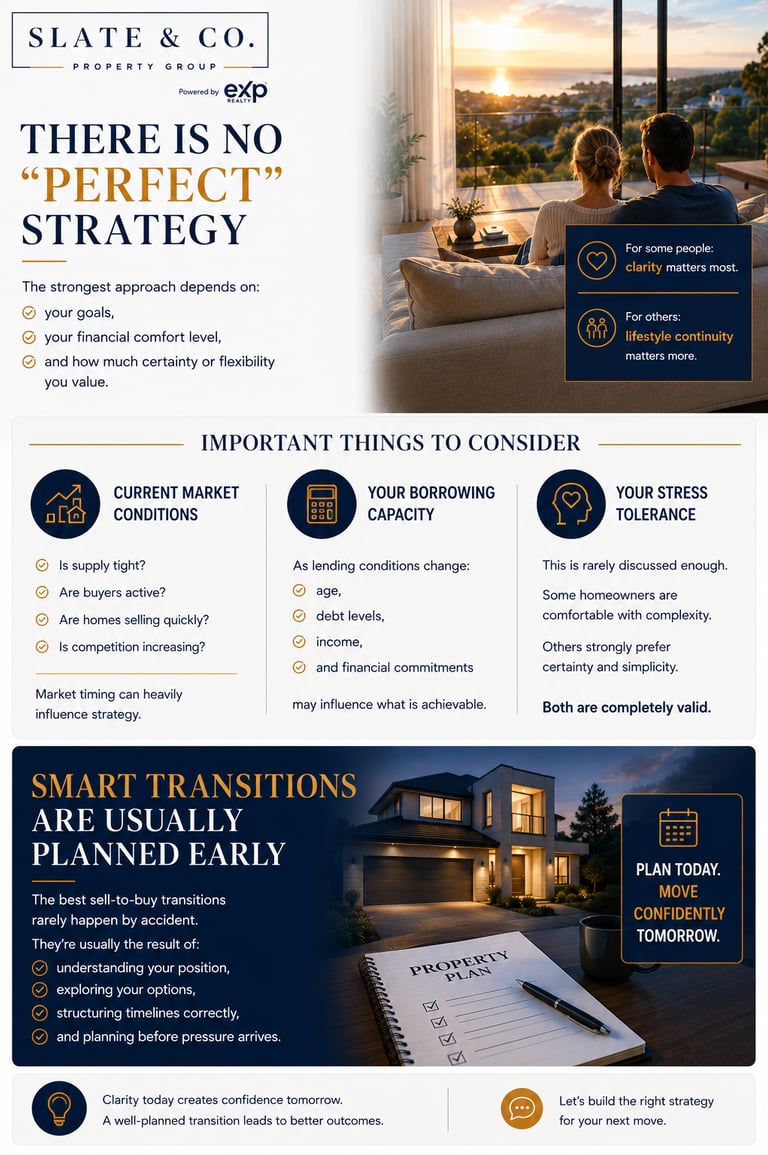

THERE’S NO UNIVERSAL RIGHT ANSWER
Many homeowners assume there is only one way to make a move happen.
In reality… there are often multiple ways to structure:
timing,
settlements,
finance,
and transitions.
The key is understanding which approach best suits:
your life,
your goals,
and your future plans.